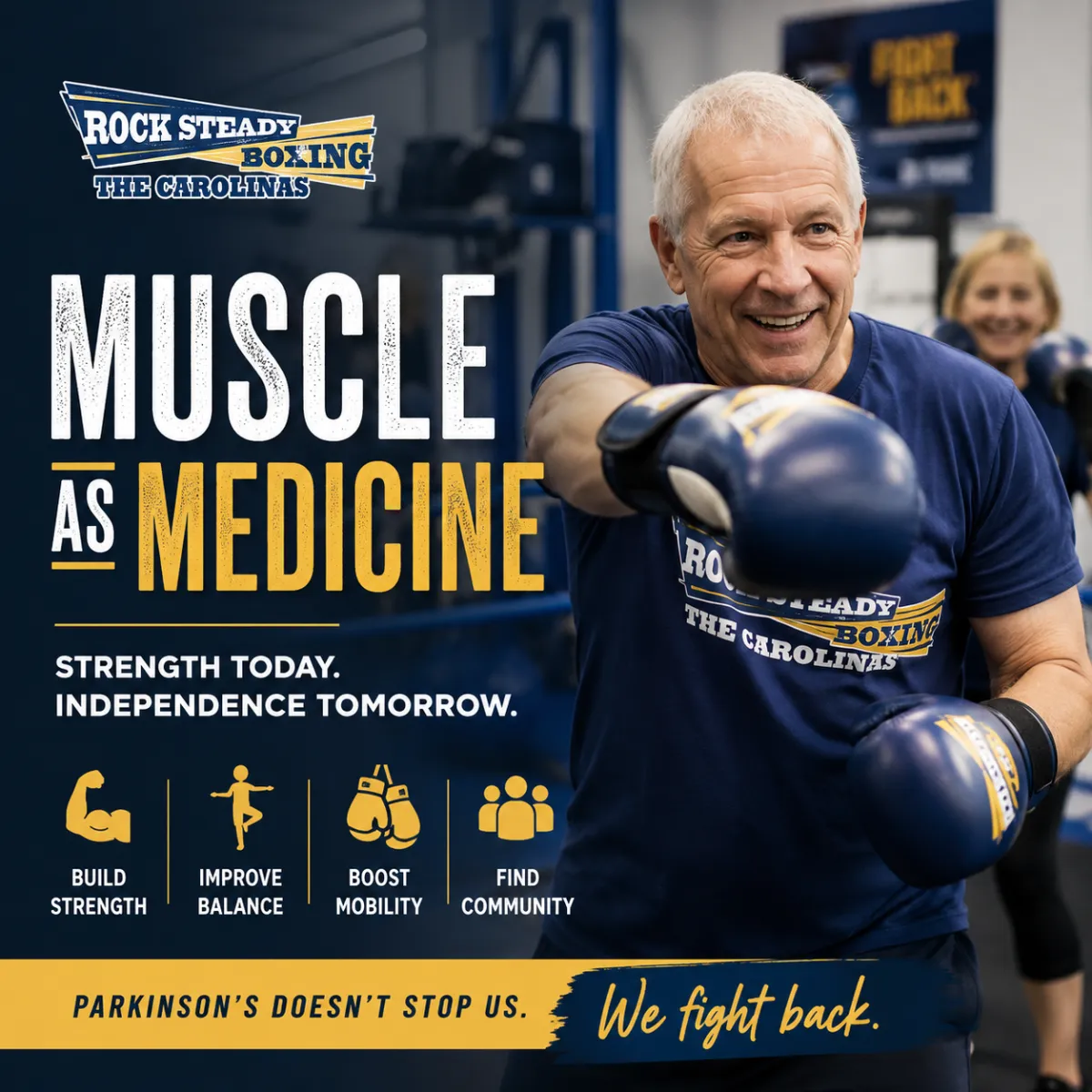
Muscle as Medicine
“This is not vanity. This is survivability.”
Muscle as Medicine
Why Preserving Strength Matters for People Living with Parkinson’s
For people living with Parkinson’s disease, movement is more than exercise. It is independence. It is confidence. It is safety. It is dignity. And in many cases, it may be one of the most important protective tools a person can build.
At Rock Steady Boxing – The Carolinas, we believe in helping Fighters preserve strength, mobility, balance, coordination, and community through coach-led, boxing-inspired fitness. But there is one idea we want every Fighter and caregiver to understand clearly:
Muscle is not just something that helps you look strong. Muscle helps you live strong.
Muscle is increasingly understood as one of the body’s most important organs of longevity. It supports movement, metabolism, blood sugar control, posture, balance, recovery, and resilience. For people with Parkinson’s, muscle weakness is common. Building muscle and maintaining strength improves balance and slows physical decline by making dopamine and medications more efficient and effective. It also addresses Parkinson’s motor symptoms, such as bradykinesia (slowness of movement) and poor posture. That’s why preserving muscle mass is more than a fitness goal. It is a protective strategy.
That does not mean every person with Parkinson’s should follow the same diet, supplement plan, or exercise routine. Parkinson’s is complex. Medication timing, digestion, appetite, swallowing, constipation, weight changes, fall risk, and other medical conditions all matter.
That is why every Fighter should speak with their physician, neurologist, pharmacist, and/or registered dietitian about a clear nutrition and strength-preservation plan. Make sure your care team understands that you want to prioritize preserving muscle mass, maintaining strength, and supporting safe movement.
This is not vanity. This is survivability.
Muscle: The Organ of Longevity
Lean muscle is often discussed as if it only matters to athletes. That misses the point by a mile.
Muscle is one of the key tissues that help us stay functional as we age. It helps us stand from a chair, climb stairs, carry groceries, stabilize ourselves when we trip, recover from illness, and remain independent.
Muscle plays a significant role in metabolic health because it helps regulate blood sugar, supports insulin sensitivity, and burns energy even at rest. Lean muscle is not only about appearance or strength; it supports health, mobility, metabolism, and quality of life as we age.
For people with Parkinson’s, that matters even more.
Parkinson’s can affect gait, posture, balance, coordination, reaction time, and confidence with movement. Over time, some people become less active because movement feels harder or less predictable. That reduced activity can create a brutal cycle:
Less movement leads to muscle loss.
Muscle loss leads to weakness.
Weakness increases fall risk.
Falls increase fear.
Fear reduces movement even more.
That is the trap. Muscle is one way we fight back.
Why Muscle Matters So Much After a Fall
People with Parkinson’s disease are at an elevated risk of falling due to impaired balance, muscle rigidity, “freezing of gait,” that feeling when the feet are stuck to the ground, and postural instability. Some people with Parkinson’s also have orthostatic hypotension, which is a sudden drop in blood pressure when standing up and it causes dizziness. Medication side effects like “off times,” when medications wear off can also affect balance and muscle control. Falls are also one of the most serious health threats for older adults. According to the CDC, falls are the leading cause of injury for adults 65 and older, and more than 14 million older adults — about 1 in 4 — report falling each year. The CDC also reports that about 37% of older adults who fall report an injury requiring medical treatment or restricting activity for at least one day. (CDC)
The danger is not only the fall itself. It is what happens after.
A fall can lead to a fracture, hospitalization, surgery, rehab, loss of confidence, reduced walking, reduced activity, rapid deconditioning, and in some cases, even death. The CDC specifically identifies poor strength and balance as risk factors that can be addressed. (CDC)
This is why muscle matters.
A stronger body may be better able to:
recover balance during a stumble,
brace during a fall,
stand up from a chair or the floor,
tolerate hospitalization or rehab,
rebuild after a setback,
return to activity sooner,
preserve independence longer.
Muscle does not make anyone fall-proof. Nothing does. But low muscle mass and weakness leave the body with less margin for error. And when Parkinson’s is already challenging movement, balance, and confidence, margin matters.
Muscle is reserve capacity.
Muscle is armor.
Muscle is the difference between “that scared me” and “that changed everything.”
Sarcopenia: The Quiet Loss of Strength
As we age, we naturally lose muscle mass and strength, a process known as sarcopenia. This loss can reduce mobility, increase fall risk, and make daily activities harder. Age-related muscle loss can lead to decreased mobility, higher fall risk, and reduced metabolic health.
For people living with Parkinson’s, sarcopenia can be especially dangerous because it may layer on top of existing movement challenges.
A Fighter may already be dealing with stiffness, slowness, balance issues, fatigue, tremor, or medication fluctuations. Add muscle loss to that picture and everyday tasks can become harder: getting out of a chair, stepping over a curb, turning in a hallway, walking to the bathroom at night, carrying laundry, or recovering after a stumble.
That is why we want Fighters and families to think about muscle early — not after a crisis.
The goal is not bodybuilding. The goal is function.
Can you stand up more confidently?
Can you walk safely?
Can you carry yourself with better posture?
Can you recover from a stumble?
Can you stay active enough to keep participating in your own life?
That is the real scoreboard.
Protein: Building Material for Muscle
Protein is an essential nutrient for maintaining and repairing muscle. It supports muscle protein synthesis, the process by which the body repairs and builds muscle tissue. Protein is essential for muscle repair and growth, and many active individuals may require more protein than the basic RDA to maintain or build lean muscle.
For older adults and people at risk of losing muscle, protein deserves serious attention.
But here is the Rock Steady-specific caution: people with Parkinson’s should not make major protein changes without discussing medication timing and nutrition goals with their medical team.
That is especially true for Fighters taking carbidopa/levodopa.
Parkinson’s Medication and Protein Timing
Many Parkinson’s patients take a regimen of carbidopa/levodopa because it helps replace dopamine in the brain. But Parkinson’s medications can interact with the timing of dietary protein. Those medications and amino acids from protein may compete for transport in the intestine and at the blood-brain barrier. For some people, a high-protein meal taken too close to a medication dose can make medication feel slower, weaker, or less predictable. Often doctors and other resources suggest patients should take their Parkinson’s medications away from meals when appropriate. But nausea can also be an issue when medications are taken on an empty stomach.
That does not mean protein is bad.
Protein is critical. Muscle preservation is critical. The answer is not to “avoid protein.” That is how we trade one problem for a bigger one.
The better question is:
How can each Fighter get enough protein to protect muscle while timing meals and medication in a way that supports their best movement?
That answer should come from the Fighter’s neurologist, pharmacist, physician, and/or registered dietitian.
Some people may tolerate protein throughout the day. Others may need to shift larger protein servings later in the day. Some may need a small low-protein snack with medication to avoid nausea. Some may have swallowing issues, constipation, weight loss, kidney disease, diabetes, or other conditions that change the advice entirely.
This is exactly why individualized medical guidance matters.
What to Ask Your Physician and/or Dietitian
Fighters and caregivers should consider bringing these questions to their care team:
How much protein should I aim for each day to preserve muscle?
Should I spread protein evenly across meals, or adjust timing because of my medications?
Should I avoid high-protein meals close to my medication doses?
What should I eat to keep my medications from making me nauseous on an empty stomach?
Am I at risk of weight loss, muscle loss, or sarcopenia?
Should I track body composition, weight, grip strength, or functional strength?
Do I have kidney, swallowing, digestion, or medication issues that influence protein recommendations?
What should I eat before Rock Steady Boxing classes, so I have energy but still move well?
What is my safest ‘ON’ window for exercise?
Should I work with a registered dietitian familiar with Parkinson’s?
The key message is simple: Tell your care team that preserving muscle is a priority.
Do not assume they know that is your goal. Say it clearly.
“I want to preserve muscle mass and strength as a protective measure. How should I manage protein, meals, and medication timing to support that goal safely?”
That conversation matters.
Resistance Training: The Signal That Tells Muscle to Stay
Protein provides building material. Resistance training provides the signal.
Combining a protein-rich diet with regular resistance training is essential for combating muscle loss, stimulating muscle protein synthesis, and maintaining or increasing lean muscle mass.
For people with Parkinson’s, resistance training does not have to mean heavy barbells, it can include:
controlled bodyweight exercises,
resistance bands,
medicine balls,
dumbbells,
functional movements,
sit-to-stand work,
farmer carries,
step-ups,
balance-supported strength work,
boxing-inspired movements,
coach-guided circuits.
The goal is progressive challenge, performed safely and consistently.
At Rock Steady Boxing – The Carolinas, the training environment matters. Fighters are not left alone to figure it out. Coaches can help modify movements, encourage effort, support safety, and build confidence.
The best program is not the perfect program written on a whiteboard. The best program is the one a Fighter can do safely, consistently, and with enough joy to keep coming back.
Muscle, Metabolism, and Energy
Muscle is metabolically active tissue. It helps the body use glucose, supports insulin sensitivity, and contributes to overall metabolic health. Lean muscle influences metabolic health, helps maintain a healthy weight, and contributes to insulin sensitivity.
This matters because many people with Parkinson’s also face other age-related health concerns: changes in appetite, weight loss or weight gain, fatigue, sleep disruption, constipation, reduced activity, blood sugar issues, and cardiovascular risk.
Muscle is not the answer to everything - but it’s connected to nearly everything.
When we preserve muscle, we are not just building strength for class. We are supporting the body’s ability to function in daily life.
The Rock Steady Boxing Perspective
Rock Steady Boxing is not a medical clinic. We do not prescribe diets, adjust medications, or replace physical therapy. That lane belongs to physicians, neurologists, pharmacists, physical therapists, occupational therapists, and registered dietitians.
Our lane is movement, coaching, community, consistency, high-level nutritional advice, and encouragement.
But we can help Fighters and families ask better questions. We can help them understand why strength matters. We can encourage them to talk to their care team about preserving muscle before weakness becomes a crisis.
We want Fighters to think about muscle and body composition as part of their long-term protection plan. Not just: “How much do I weigh?”
But:
How strong am I?
How well do I move?
Can I stand up from a chair?
Can I recover from a stumble or a fall?
Am I eating enough to support muscle?
Am I timing food and medication well?
Am I training consistently?
Am I protecting my future independence?
Practical Takeaways for Fighters and Caregivers
1. Prioritize muscle preservation early.
Do not wait until strength has declined. Muscle is far easier to protect than rebuild.
2. Talk to your medical team.
Ask your physician, neurologist, pharmacist, or registered dietitian how to balance protein intake, medication timing, and muscle-preservation goals.
3. Do not fear protein — understand timing.
For some people taking carbidopa/levodopa and other Parkinson’s medications, protein timing matters. That does not make protein the enemy. It means the plan needs to be smarter.
4. Train strength safely and consistently.
Resistance training helps the body to maintain or build muscle. At Rock Steady, that work is built into a supportive, coach-led environment.
5. Think beyond the scale.
Weight alone does not tell the full story. A person can lose weight and lose muscle, which may reduce strength and resilience. Body composition, function, and strength matter.
6. Build fall resilience.
Balance matters. Coordination matters. Strength matters. If a fall happens, muscle may help improve the odds of recovery.
7. Stay connected.
Isolation is dangerous. Community creates accountability, consistency, and hope. At Rock Steady, the room matters as much as the workout.
8. Book a Body Composition scan
This scan, along with a consultation with our resident nutritionist, offers Fighters an opportunity to get a baseline reading of their lean muscle mass and body.Get a high-level overview of macro-nutritional considerations to help optimize your diet.
Conclusion: Muscle Is Protection
For people living with Parkinson’s, muscle is not cosmetic. It is protective.
·It supports movement.
·It supports metabolism.
·It supports balance.
·It supports recovery.
·It supports confidence.
·It supports independence.
And in the event of a fall, illness, hospitalization, or setback, muscle may be one of the body’s most important reserves.
At Rock Steady Boxing – The Carolinas, we believe every Fighter deserves the chance to keep building strength, confidence, and community. The work is serious, but it does not have to be joyless. We train hard. We laugh. We adapt. We show up. We fight back together.
If you or someone you love is living with Parkinson’s, talk with your care team about making muscle preservation a priority. Ask about protein. Ask about medication timing. Ask about strength training. Ask about fall risk. Ask how to protect independence for as long as possible.
Then come move with us - because muscle is more than strength.
Muscle is medicine.
